
Scaling a business requires both capital and strategic expertise. While traditional methods such as bank loans, public offerings, or family funding remain popular, private equity (PE) has emerged as one of the most powerful tools for driving sustainable growth. Unlike conventional financing, private equity does more than inject money—it brings industry expertise, operational improvements, and strategic direction.
What is Private Equity?
Private equity refers to investment made directly into private companies (or public companies that are later taken private) by specialized investment firms or funds. These firms typically acquire significant ownership stakes, actively partner with management, and focus on enhancing long-term value before eventually exiting through a sale, merger, or public listing.
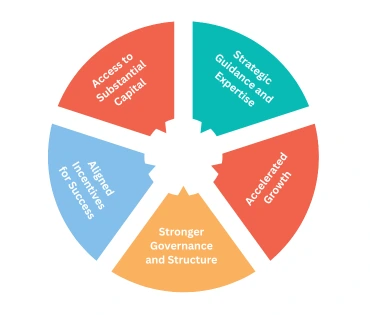
Benefits of Private Equity
Access to Substantial Capital
Unlike traditional bank loans, which may limit growth to debt servicing capacity, PE firms provide large-scale capital without burdening businesses with heavy interest obligations. This allows companies to make bold investments in expansion, acquisitions, or new product development.
Strategic Guidance and Expertise
Private equity investors bring industry knowledge, seasoned advisors, and networks of professionals. They often help optimize operations, strengthen governance, and guide decision-making—something that money alone cannot achieve.
Accelerated Growth
With both capital and expertise, businesses can scale faster. PE-backed companies often expand into new markets, acquire competitors, or adopt advanced technologies more efficiently than those relying solely on internal resources.
Stronger Governance and Structure
PE investors typically introduce best practices in financial reporting, risk management, and leadership structures. This professionalization not only enhances performance but also boosts credibility with future investors, lenders, and partners.
Aligned Incentives for Success
Private equity firms succeed only when the business grows and creates value. This alignment ensures a shared focus on performance, profitability, and long-term returns.
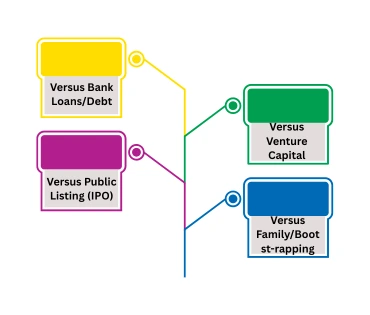
How Private Equity Differs from Other Ways to Scale
1. Versus Bank Loans/Debt
- Debt financing requires repayment with interest, regardless of whether the business is performing well.
- Private equity does not demand monthly repayments but instead focuses on long-term value creation, reducing short-term financial pressure.
2. Versus Venture Capital
- Venture capital (VC) usually funds early-stage startups with high growth potential but also high risk.
- Private equity generally targets established companies that need capital and strategic support to scale further.
3. Versus Public Listing (IPO)
- IPO opens the company to public investors but brings intense regulatory requirements, market volatility, and shareholder pressures.
- Private equity keeps the business private, allowing management to focus on growth strategies without the constant scrutiny of quarterly results.
4. Versus Family/Bootstrapping
- While internal funding ensures control, it limits the scale of growth.
- Private equity expands possibilities by combining external resources with professional management practices.
Conclusion
Private equity is more than just an investment mechanism it is a partnership designed to transform businesses. By offering capital, strategic direction, and operational excellence, PE helps companies scale more efficiently than traditional financing routes. For ambitious entrepreneurs and family-owned businesses aiming for rapid yet sustainable expansion, private equity stands out as one of the most impactful growth strategies available today.