

In today’s rapidly evolving tech landscape, innovation alone isn’t enough to guarantee growth. Emerging tech businesses often reach a point where scaling operations, expanding market presence, or accelerating product development requires more than just vision it requires strategic capital and experienced partners. This is where Private Equity (PE) steps in as a powerful enabler of growth.
What is Private Equity?
Private Equity refers to investment capital from high-net-worth individuals, institutions, or funds that invest directly in private companies or take public companies private to drive long-term value creation. Unlike traditional financing, PE investors bring not only funding but also strategic guidance, operational expertise, and a network of industry connections.
Why Private Equity is a Viable Option for Tech Businesses
Tech startups and emerging companies face unique challenges from constant innovation cycles to scaling infrastructure and talent. PE firms are well-positioned to help address these through:
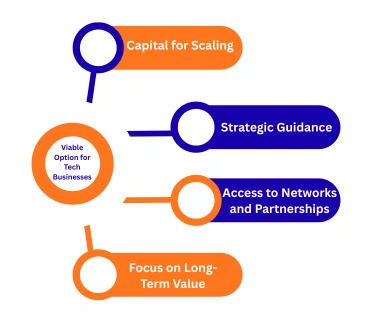
1. Capital for Scaling:
PE investors provide substantial growth capital that enables tech businesses to expand operations, enter new markets, and invest in R&D without relying solely on debt or dilutive equity rounds.
2. Strategic Guidance:
Beyond capital, PE firms bring seasoned professionals who understand how to structure teams, optimize processes, and streamline operations crucial elements for scaling sustainably.
3. Access to Networks and Partnerships:
Emerging tech firms often lack access to enterprise clients or distribution networks. PE investors open doors to strategic partnerships, helping tech products gain market traction faster.
4. Focus on Long-Term Value:
Unlike venture capital, which often pushes for quick exits, private equity typically takes a longer-term approach aligning with founders who aim to build enduring businesses rather than short-term valuations.
How Emerging Tech Businesses Can Prepare for Private Equity
Before engaging with PE investors, tech founders should:
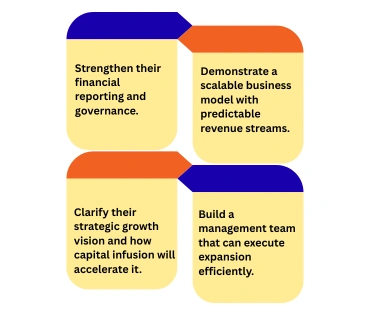
- Strengthen their financial reporting and governance.
- Demonstrate a scalable business model with predictable revenue streams.
- Clarify their strategic growth vision and how capital infusion will accelerate it.
- Build a management team that can execute expansion efficiently.
Conclusion
Private Equity is no longer reserved for large corporations it’s increasingly becoming a strategic partner for emerging tech businesses seeking to accelerate growth, professionalize operations, and expand globally. With the right alignment, PE funding can transform a promising tech startup into a sustainable, market-leading enterprise.