

Family businesses form the backbone of economies worldwide, combining entrepreneurial spirit with deep-rooted values. Despite their unique strengths, many family-owned firms face challenges in scaling operations, professionalizing management, and navigating generational transitions.
Private equity (PE) has emerged as a powerful partner in helping these businesses achieve their maximum potential, blending capital infusion with strategic guidance.
Professionalizing Growth and Governance
One of the most significant contributions of private equity to family businesses is the introduction of structured governance and professional management practices. PE firms bring frameworks for decision-making, reporting, and accountability that complement the family’s long-term vision. By implementing clear boards, performance KPIs, and structured oversight, PE partners help families avoid operational bottlenecks and ensure sustainable growth.
Capital for Expansion and Transformation
Access to growth capital is often limited for family businesses; however, this challenge becomes even more pronounced when they aim to expand into new markets, invest in advanced technologies, or pursue strategic acquisitions.
In such cases, private equity plays a critical role by providing the necessary financial resources. As a result, family businesses can confidently execute these initiatives, accelerate growth, and strengthen their long-term competitive position.
Beyond funding, PE partners often assist with M&A, digital transformation, and operational efficiency projects, ensuring that investments translate into tangible value creation.
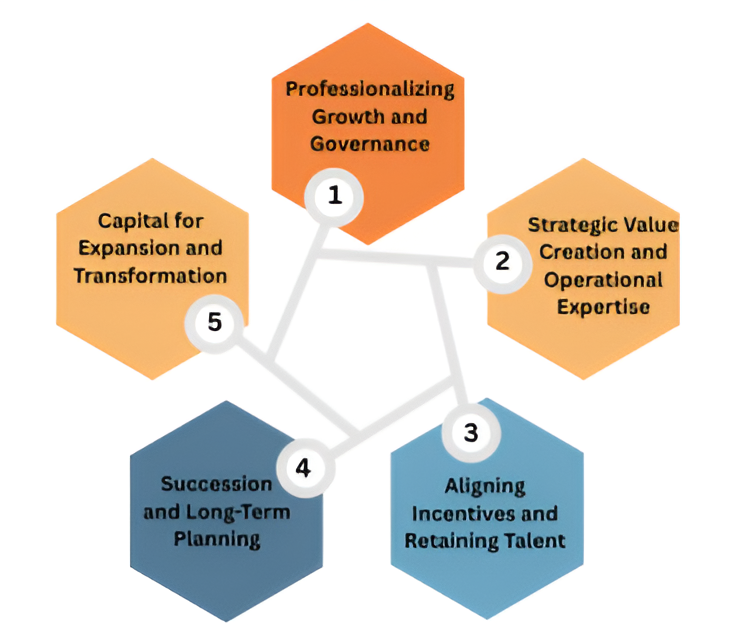
Strategic Value Creation and Operational Expertise
PE firms bring more than capital they bring deep operational and sector expertise. From optimizing supply chains and implementing lean processes to enhancing pricing strategies and customer segmentation, PE-backed family businesses benefit from actionable insights that drive profitability. This combination of strategic guidance and operational rigor allows family firms to compete effectively in increasingly complex and competitive markets.
Furthermore, Private Equity firms often introduce data-driven decision-making and performance benchmarking. By leveraging industry best practices and peer comparisons, family businesses gain clearer visibility into operational gaps and growth opportunities, enabling faster and more informed strategic actions.
Succession and Long-Term Planning
Transitioning leadership from one generation to the next is a challenge that many family businesses struggle to navigate. PE involvement can smooth succession planning by establishing clear leadership structures and offering mentorship and coaching. By aligning the interests of the family, management team, and investors, PE ensures continuity while fostering long-term value creation.
Aligning Incentives and Retaining Talent
Retaining top talent is critical for scaling family businesses, yet many struggle with professionalizing compensation and career paths. PE introduces performance-linked incentives, equity participation, and long-term retention strategies, aligning management and family goals with the firm’s growth trajectory. This motivates leaders to focus on operational excellence and strategic execution.
By introducing professional HR frameworks, private equity partners also help family businesses build stronger leadership pipelines. This ensures that future growth is supported by capable managers across functions, not just at the ownership level.
Conclusion
Private equity has proven to be a transformative partner for family businesses seeking to unlock their full potential. By providing capital, strategic guidance, operational expertise, and governance frameworks, PE helps these firms achieve sustainable growth, professionalize management, and prepare for generational transitions.
For family businesses aiming to compete at the highest level, private equity is not just a funding source—it is a catalyst for long-term success.